Our Methodology
A five-stage framework for executive career positioning — starting with who you are, then building demand for your leadership.
The Strategic Problem
Most career services start with a resume. Some start with a strategy. Almost none start with the question that determines whether everything else works: who are you at this stage of your career, and what would the right next chapter actually look like?
Senior leaders in transition face a challenge that tactical career services cannot solve. The executives who land well — who secure roles that match their ambition, compensate their value, and sustain their energy — are not the ones who optimized their resumes fastest. They are the ones who arrived at the market with clarity about their identity, direction, and differentiators.
That clarity is what our methodology is designed to build.

The Two-Part Framework
Our methodology has two interconnected components. The first is the inner work: defining who you are, what you want, and what constrains you. We call the output of this work the Personal Compass — your identity profile that becomes the foundation for every decision that follows.
The second is the market-facing work, powered by the Demand Formula. In the marketplace for talent, demand for your services is driven by four factors:
Visibility
The broader market needs to be aware of you.
Perceived Value
Hiring managers and potential clients have to understand the value of your experience and expertise.
Relevance
Your skills and expertise need to be current and ready to solve the immediate business needs of your potential clients and employers.
Scarcity
The marketplace needs to understand why you are uniquely suited to solving certain business problems.
Demand = Visibility × Perceived Value × Relevance × Scarcity
These four variables are multiplicative, not additive. Weakness in any single dimension has a disproportionate effect on reducing demand. An executive with extraordinary credentials but no visibility to decision-makers generates the same market demand as a visible executive with undifferentiated credentials. The system works only when all four are strong.
The Personal Compass gives you a destination. The Demand Formula gives precise insight into how to get there. Without the first, you risk building demand for a version of yourself that doesn’t match what you want. Without the second, you have clarity without traction.
Stage 1 The Design — Building the Personal Compass
Before we develop strategy, build brand assets, or conduct outreach conversations, we invest in the work that makes everything else coherent. The Design stage is a structured exploration of eight dimensions of professional identity:

Purpose
Why do you work? What problems intrigue you regardless of institution or title?

Values
What is non-negotiable — philosophically and practically? What do you believe work is for, and does that belief align with what you believe makes a good life?

Career Arc
What is the through line across your entire career? What pattern emerges when you look at the whole trajectory, not just the last role?

Career Archetype
What type of professional are you? Where do you create disproportionate value? What are your shadow patterns — the tendencies that serve you in some contexts and undermine you in others?
Leadership
Expression
How do you lead? What is your management philosophy? How do you show up in a room, build trust, and move people?

Energy Map
What environments, problems, rhythms, and people energize you? What depletes you? This is the bridge between identity and design — the difference between a role you can do and a role you want.

Non-Negotiables
Compensation floor, location, healthcare, travel tolerance, schedule, promotion path. These are the boundary conditions on your design — practical constraints that eliminate options before strategy work begins.

Vision
What does the life you want to be living actually look like? For clients wrestling with multiple futures, we develop alternative scenarios to pressure-test direction before committing resources.
We consolidate all of this into the Personal Compass document that can be a useful reference to return to for future transitions. For the Excelsis process, it becomes the reference point for the design of your career strategy. Research on executive transition psychology confirms that identity disruption and purpose recalibration are the primary barriers to effective transition. Most career advisors and strategists skip this work. We find it central to a successful transition so we develop it and build on it.
Stages 2–5 — The Demand Formula in Action
With the compass set, we build demand for your leadership across the four dimensions.
Stage 2 | The Strategy → Strengthens Relevance
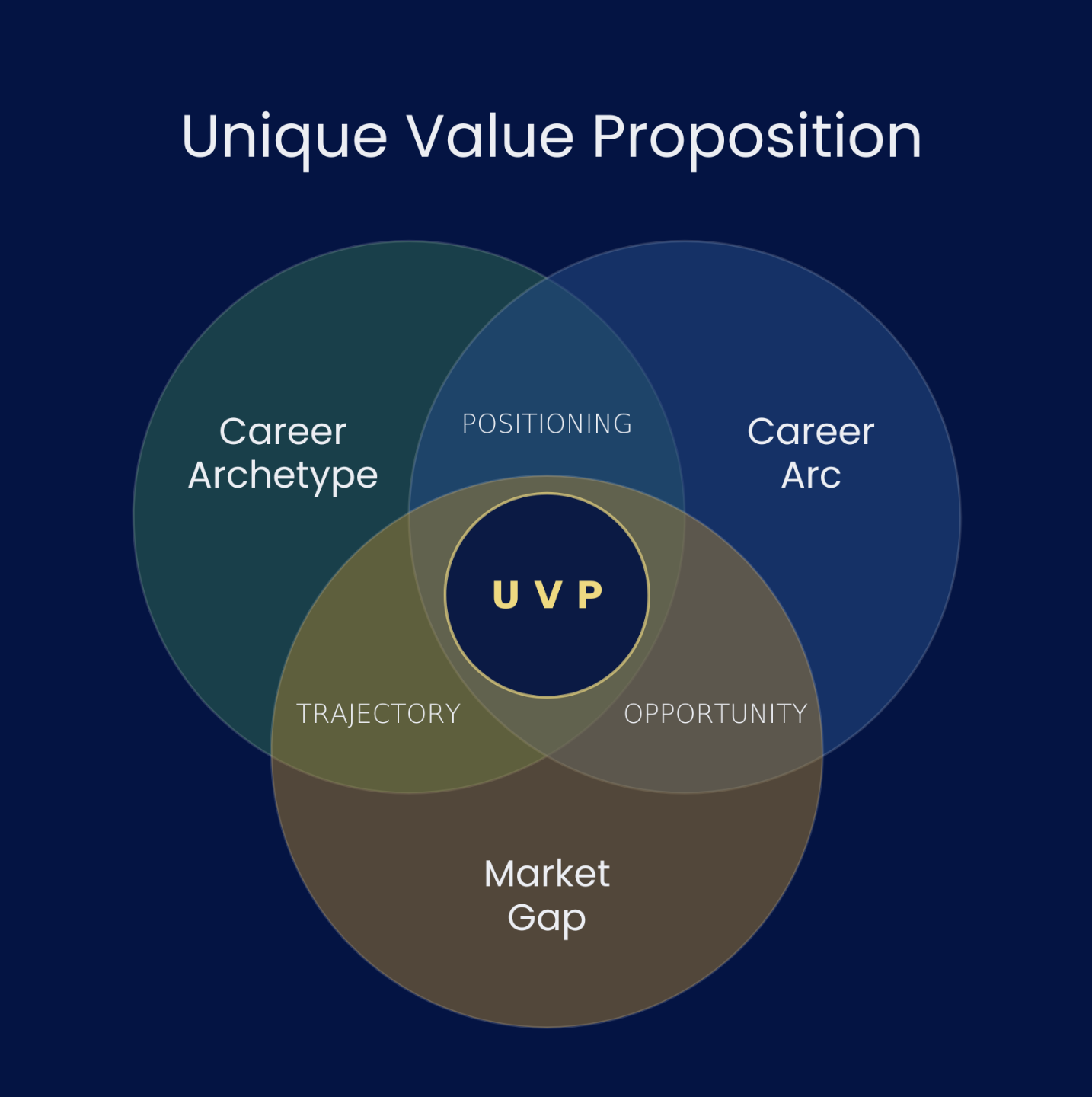
We assess your current market position, identify gaps, and build a strategic plan anchored to your Personal Compass. The critical output is your Unique Value Proposition which is the single differentiating position that unifies everything from your resume to your interview narrative. The UVP sits at the intersection of your archetype (how you approach work), your career arc (what skills and experience you bring that others don’t), and the market gap (what target organizations need that’s undersupplied). Includes target organization portfolio, compensation benchmarking, SWOT analysis, and competitive positioning.
Stage 3 | The Brand → Enhances Perceived Value and Scarcity
We build the professional assets that communicate both your inner identity and your market position. These include an executive resume, a LinkedIn profile, leadership narratives, elevator pitches, STAR stories, and positioning materials all unified around your UVP. In a market where emotional intelligence has become the top executive hiring filter and skills-based assessment is becoming standard, these are not documents for a single search. They are strategic instruments that articulate who you are, what you deliver, and why you are difficult to replace.
Stage 4 | The Campaign → Builds Visibility
With positioning and brand set, we activate strategic outreach, network development, and engagement with your target market. Mock interviews test narrative delivery. Compensation negotiation preparation ensures you enter those conversations with data and confidence. We take special care to help you build lasting relationships during the campaign. Relationship capital in the form of a durable network that generates opportunity continuously is the ultimate goal and how build credibility and demand for your services even after your accept a new position.
Stage 5 | The Launch → Increases Value and Scarcity
We convert a signed offer into early authority. A 90-day strategic plan maps organizational politics, identifies stakeholders, and sequences early wins that establish credibility. Executive search firms now measure placement success 12–24 months after appointment. The Launch stage is designed to help you enter a new organizational culture equipped to quickly get your bearings, build internal networks and deliver visible results that will accelerate your upward trajectory.
This methodology reflects our view, supported by competitive analysis and market research, that the executives who transition best are not the ones who searched hardest. They are the ones who knew who they were, built demand for their leadership across every dimension that matters, and entered the market with confidence and focus.